Skip to the text
Inner Axiom

The Pleiades, the Seven Sisters in Taurus and Orion

INSCRIBED BYetiric
PUBLISH DATEJul 28, 2026
READING TIME7 min
Codex Markings
The Pleiades, the Seven Sisters in Taurus and Orion

The Pleiades, the Seven Sisters in Taurus

The Pleiades are an open star cluster in the constellation Taurus; they are known as Messier 45, or the “Seven Sisters.” Unlike many older, densely packed globular clusters, an open cluster consists of loosely grouped, young stars bound by gravity that formed from the same gas cloud.

The Seven Sisters

The name “The Seven Sisters” derives from the seven brightest members: Alcyone, Maia, Electra, Merope, Taygete, Kelaino, and Sterope.

Under normal conditions, however, only six are clearly visible to the naked eye. The invisible star, usually Merope or Kelaino, lies close to the limit of human vision. This detail of a real photometric phenomenon has given rise to stories about the “lost” or “hidden” sister in numerous independent cultures.

Golden Gate of the Ecliptic

This term, which I have already used in other articles, is a genuine astronomical term. Its counterpart, the “Silver Gate,” however, is still regarded as an “esoteric” concept in the minds of astronomers.

The Pleiades, together with their neighboring star cluster, the Hyades, form a constellation known as the “Golden Gate of the Ecliptic.” This term is firmly established in astronomical vocabulary and well documented in archaeoastronomy.

Of particular interest here is a rock engraving from the Paleolithic era, dating back approximately 21,000 years, found in the Tête-du-Lion Cave (Ardèche, France), which is interpreted as an early observation of this gate. Furthermore, between approximately 4000 and 1500 BCE, the vernal equinox occurred precisely in this region, which gave the constellation Taurus special significance in many early cultures.

An aurochs on a wall of Lascaux cave (a) compared with the map of the sky (b), adapted from Ref.4.

Greek Mythology: Established Tradition

The Pleiades are widely mentioned in ancient literature:

  • Hesiod (Works and Days)
  • Homer (Iliad and Odyssey)
  • Apollodorus (Bibliotheca)
  • Ovid (Fasti / Metamorphoses)
  • Hyginus (Astronomica)

Lineage

The best-known version identifies the Pleiades as the daughters of the Titan Atlas and the Oceanid Pleione. There is also a different tradition (Pseudo-Hyginus, following Musaios) that instead names the Oceanid Aithra as their mother and originally describes fifteen daughters, from whom both the Hyades and the Pleiades emerged as a result of grief.

Name (Greek)Meaning / EtymologyBest-Known Connection
Maia“the Great One / Nurse”Mother of Hermes (by Zeus)
Electra“the Radiant One”Mother of Dardanus, matriarch of Troy
Taygetenamed after Mount TaygetosMother of Lacedaemon (with Zeus)
Kelaino“the Dark One”Mother of Lycus (with Poseidon)
Alcyone“the Repelling One”Mother of several children of Poseidon
Sterope (Asterope)“the Flash”Sometimes referred to as the “lost Pleiade”
Merope“the Mortal”the only one to marry a mortal (Sisyphus)

The “Hidden” or “Lost” Pleiade

The disappearance of the seventh sister is not consistently explained in ancient mythology.

This is especially true given the story of Merope, who hid herself out of shame because she was the only one of the sisters to marry a mortal; Electra, who withdrew from her sisters out of grief over the fall of Troy, the city of her son Dardanos; and a secondary tradition that explains Electra’s fading light by stating that she subsequently became a comet.

This diversity is typical of Greek mythology, as it was repeatedly reworked over the centuries, both orally and in literature.

Orion and the Pursuit

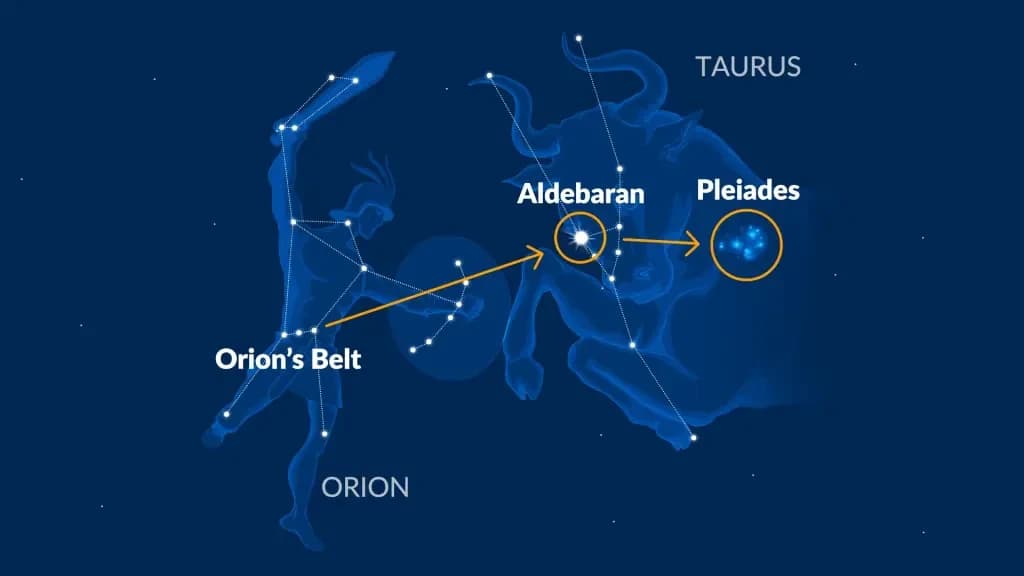
The central narrative of the pursuit is well-documented, but differs from the original text in one important respect. Ancient sources (including Ovid’s Metamorphoses and Pseudo-Hyginus) speak of a pursuit lasting seven years, not an eternal chase in the earthly sense.

Their father Atlas was condemned to carry the sky on his shoulders, leaving his daughters defenseless and allowing Orion to pursue them unhindered. It was only through the intervention of Zeus, who - out of pity for the sisters - transformed them, according to one version, first into doves, then into stars, Orion was raised to the heavens and has since pursued the Pleiades across the firmament in the form of a constellation, without ever catching up to them.

Connection to Artemis

The identification of the Pleiades as Artemis’s virginal companions is well documented (see, among others, Pseudo-Apollodorus). They were not merely beautiful maidens, but were consecrated, set apart, and untouchable; and it was precisely their virginity that made Orion’s pursuit in the myth so charged with significance.

Here we find a recurring theme in ancient star myths: pursuit, vulnerability, and divine intervention as an explanation for an astronomical phenomenon. In this case, the seemingly eternal movement of Orion and the Pleiades across the night sky.

Worldwide Prevalence of the “Seven” Motif

The number seven is found as a signature of the cluster in every culture: as “Vergiliae” among the Romans, “Subaru” in Japan, “Matariki” among the Māori (New Year’s festival), as an abbreviation for seven stars in Revelation 1:16, and in the Japanese company name Subaru, whose logo directly symbolizes the six visible stars of the cluster. This widespread cultural presence is well documented and undisputed; it is simply because the cluster is one of the most striking objects in the night sky and can be observed worldwide.

The Book of Job

Job 38:31

Can you bind the Pleiades in a cluster or loose the cords of Orion?

This verse is an authentic and one of the oldest literary references to the observation of these two neighboring star formations as a paired group. It reflects actual Babylonian and Near Eastern celestial observations, but serves as a poetic image for the unfathomably of creation.

Symbolic and Esoteric Interpretation

I hope the reader is aware of the importance of the aforementioned facts and can understand why I did not immediately bombard them with the esoteric meaning.

Kartikeya, Mahisha, and the “Spear of the Pleiades”

In Hindu tradition, the Krittikas (Sanskrit for the Pleiades) are the six foster mothers of the god of war Kartikeya (also known as Skanda or Murugan), who was born from six sparks of Shiva’s flame. Kartikeya carries a spear (vel). In the widely accepted mainstream tradition, however, it is the goddess Durga, not Kartikeya, who defeats the buffalo demon Mahishasura.

The Pleiades are said to be depicted as a “weapon” of cosmic order, the spear of Kartikeya (the deity corresponding to Orion/Horus), the weapon with which he slew the Bull (Taurus). In the sky, this is expressed as Orion using the Pleiades as the tip of his thrust into the shoulder of the Bull.

Depiction of Kartikeya with his spear

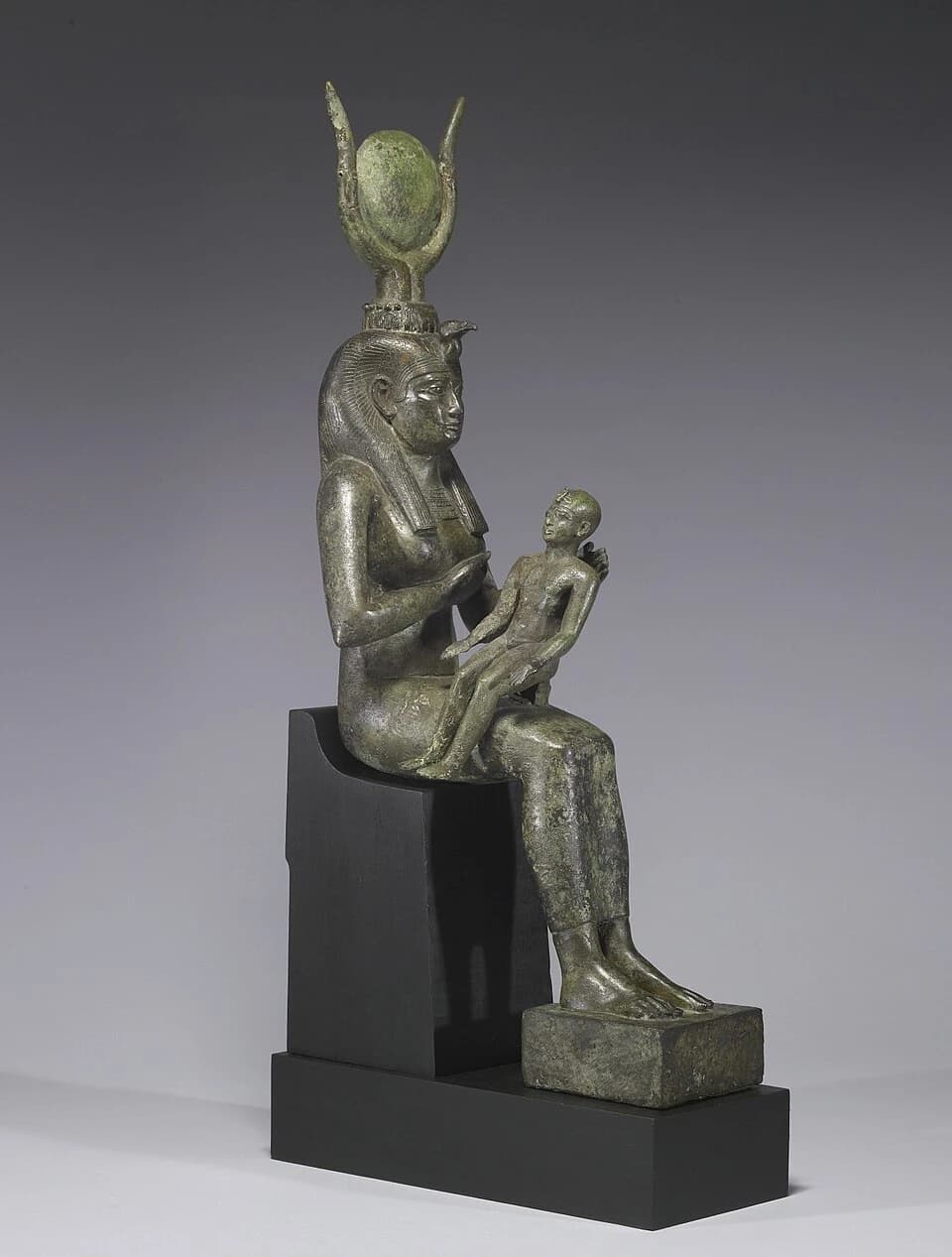
The goddess Durga is interesting because, unlike other goddesses, she is not associated with a male god; furthermore, in Tantrism, as Shakti, she represents the primal feminine power of the universe and is equated with Isis in the esoteric teachings.

The Pleiades as Pillars of the Golden Gate

The Pleiades, together with the Hyades, form the twin pillars of what is called the Golden Gate of the ecliptic. It is the visible gate in the region of Taurus. The Pleiades are considered one pillar; the Hyades (with Aldebaran at their center) the other. Thus, the earthly pillars Jachin and Boas at Solomon’s Temple are a counterpart to the Golden Gate in the heavens (Taurus). “As above, so below

Symbolism of Disasters

In several premodern agrarian cultures (including pre-Spanish Mesoamerica and parts of the Middle East), the heliacal rising or setting of the Pleiades marked points in the agricultural year associated with rainy seasons, the end of the harvest, or ritual festivals (such as the Aztec “New Fire” ceremony held every 52 years). They were not only nurturing sisters; they also bore the weight of cosmic timekeeping and renewal through destruction. (See Revelation 1:16)

References

Mark the Fragment

Return to leave a mark.

Resonant Fragments
Previous fragment·KThe Esoteric Teachings of the Planet IsisJ·Next fragmentISIS: The Godess, From An Esoteric Perspective
Echoes (0)
Return to leave an echo.