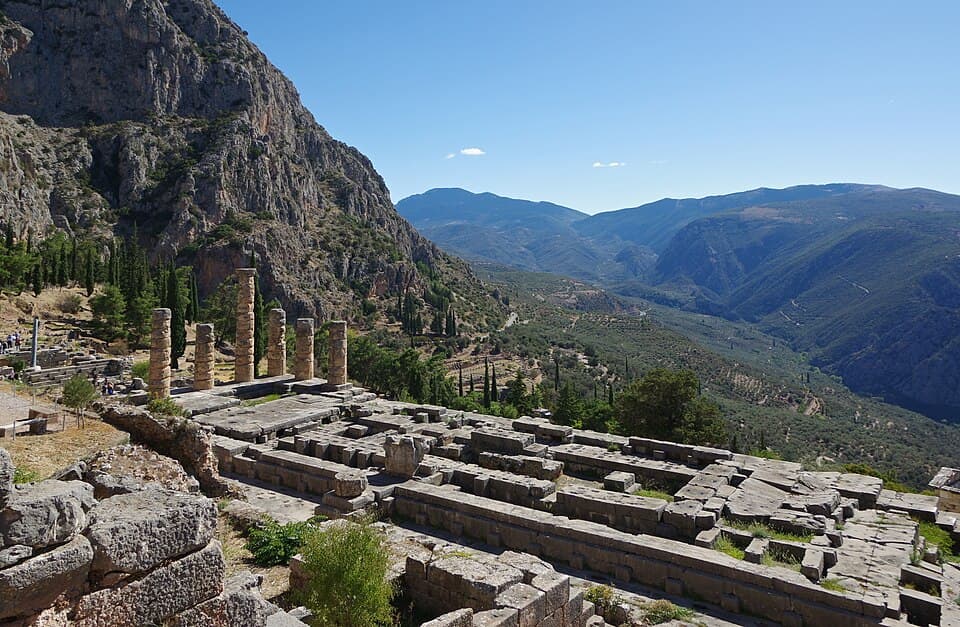
The Sanctuary of Delphi
Codex Markings▾

The Sanctuary of Delphi
The Navel of the World
In the oldest strata of myth, the father-god Zeus released two swans simultaneously from opposite ends of the world, one from the light and one from the dark, and where they met, he marked the center of all things. The Greeks called this place, set on the southern slope of Parnassus, the Navel of the Goat, a reference to the primordial goat Amaltheia, who surrendered herself to Apollo in the form of a cloud.
Amaltheia symbolized the virgin primordial matter: the subtle agent of the Tabula Smaragdina, the Quintessence of the alchemists. Through her, the form-giving forces of the great mother, the earth-goddess Gaia, were transmitted to all that grows and becomes. At that time, Gaia herself still stood entirely under the influence of the adversary of the divine light: the daemon of Saturn.
From a fissure in the earth, the breath of the underworld rose upward. The shepherds of the surrounding lands were the first to hear the voices of mother Gaia and of Themis, mistress of Karma. As a symbol of the fertilizing forces at work in this place, early humanity erected the sacred navel-stone, the Omphalos, in the form of a phallus wrapped in woven wool. Over time, a sacred site took shape: the later Delphi.
The Guardian of the Threshold
Before the light could dwell there, the underworld had to be reckoned with. The demons of the deep had appointed the dragon Python as warden and guardian of this district. The magi of antiquity erected a tripod above the earth's fissure, borne by a three-headed serpent, the seat of the priestesses of the dark powers, mediums through whom the chthonic daemons found their voice.
The Coming of Apollo
Then came the time when the radiant god of light, Apollo, approached from the east. The mythic tradition places this arrival at the same age in which the Argonauts brought the Golden Fleece from Colchis to Hellas, or expressed differently, when the vernal point had advanced far enough through the zodiac that the solar influence extended from the eastern lands onto the Balkan peninsula, causing Greek culture to bloom.
Apollo came to take possession of the sanctuary, but first he had to break the resistance of the opposing powers. He slew the dragon Python and allowed him to dissolve beneath the rays of the sun, transforming him into fertile earth. Even Heracles, still bound to the older age, attempted to withhold the sacred tripod and divert it elsewhere. But even his giant strength was no match for the power of the divine light. The tripod was surrendered.
A new age began. No longer would this site serve the adversarial powers. The sphere of the sun had expanded, and Delphi was to become a point of emanation for light-bearing impulses. A temple to Apollo was built, and virgin priestesses, consecrated to the radiant god, mounted the tripod and, transfigured by the light of the world, gave answer to all who came seeking guidance. It was the healing Logos itself that streamed from the mouth of the god-filled Pythia.
Apollo and Dionysus: Two Faces of the Divine Son
Yet Apollo was not considered present throughout the entire year. During the winter months, tradition held that he withdrew to his luminous homeland, the northern realm of the Hyperboreans, a place not to be sought on any earthly map, for the kingdom of the spirit is not of this world. In his absence, a surrogate held watch at the sanctuary: Dionysus.
The front pediment of the temple bore scenes from the myths of Apollo; the rear pediment, scenes from the myths of Dionysus. Within the cella, beside the golden statue of Apollo, stood the tomb of Dionysus. To understand what this means, one must look more closely at the nature of each god.
Apollo
Apollo is a son of the father-god Zeus. The mortal Leto, a daughter of the Titans and a child of Night, received the fertilizing ray of the Kronide and bore the twin pair: Apollo and Artemis. On the island of Delos, nourished by nectar and ambrosia, Apollo grew into a magnificent, fire-drunk youth, and it was to him that Amaltheia surrendered herself in the form of cloud. This union with the prima materia marks him as a being not purely spiritual, but simultaneously subtle-material: capable of ascending to Olympus swift as thought, and descending again into the depths of the material world, mediating between above and below, creating, dissolving and renewing, harmonizing apparent opposites, and streaming forth as divine Logos from the mouth of the Pythia.
He is the lord of light and the sun, the vanquisher of the dragon, he who bends the spirits of the underworld to his service. As the good shepherd, he tends the flocks that have no guardian. He is the healer, father of the miracle-working Asclepius, and the cosmic archetype of humanity, shining eternally youthful and beautiful from the celestial houses of the zodiac.
Dionysus
Dionysus is more ambiguous, harder to fathom. He too is a son of Zeus, but his mother is Persephone, daughter of Ceres and later goddess of the underworld. He appears more bound to the lower regions of density and matter, though he rivals Apollo in his eternal youth and beauty.
Dionysus appears in many forms: as the mystical serpent Pareia, as satyr, as bull, as lion, as panther. These symbols alternately draw him toward the earth and Saturn-nature, or emphasize the solar principle dwelling within him.
In one telling, as a youth he was seized by pirates, bound, and dragged aboard a ship. To the astonishment of his captors, the fetters fell away. A mighty vine climbed up the mast and spread in branches heavy with grapes, forming a canopy over the entire vessel. Simultaneously, a great lion appeared on deck, throwing the pirates into such terror that they leapt into the sea and were transformed into dolphins.
The vine consecrated to the god speaks of one who strives upward from below, unfolding and bearing fruit. Dionysus is most widely known as the god of wine, the enflaming, intoxicating drink that fills the drinker with enthusiasm and allows the god to enter. Intoxication, in its higher sense, is meant to awaken the hidden spiritual dimension and bring it to expression. For this reason, Dionysus wanders the world for three years as an incarnate son of god, teaching all peoples the cultivation of the vine and the law.
Among his retinue walks Silen, who in the state of intoxication reveals the deepest truths about the origin of the world and the eternal cycle of things. God-intoxicated too are the Thyiades, who at the winter solstice climb the peak of Parnassus in great numbers, to allow the divine child to rise again within their hearts.
The Mirror in the Heights
As Apollo, enveloped in the cloud of Amaltheia, descends from heaven to the primordial ground and rises again from the primordial ground to heaven, so too does Dionysus require this veil of primordial matter in order to ascend to the seat of the Kronide. This is hinted at by one of his epithets: Dionysus in the black goatskin.
In this garment, the youthful god ascended to his father, who rejoiced over his beloved son and allowed him to play with his lightning and thunder. It was here, in the heights, that Dionysus gazed into a mirror, and in that same moment was set upon by the surging Titans, slain, torn to pieces, and devoured. In remembrance of this, the priests of Delphi offered secret rites at the god's tomb on the shortest day of the year.
But Dionysus only died in order to be born again, from Semele. When Semele could not endure the full majesty of Zeus and perished as the god revealed himself in unmediated glory, Zeus took the unborn child from the mother's womb and allowed him to ripen in his own thigh, from which the divine son rose again in imperishable youth and beauty.
What did Dionysus see in the mirror in the moment the Titans fell upon him? This is an esoteric mystery, perhaps communicated to those who underwent initiation. But the Mystery sites have long fallen into ruin. Who can reveal the secret to us now?
We must descend into the Adyton and ask the Pythia. This underground, barely accessible chamber lies today within ourselves. It is the "inner room" of the Gospel, into which we are told to enter in order to pray; the "tabernacle," our aura, when we have shielded it completely from all external happening.
There I found the Pythia and asked: "What did Dionysus see in the mirror, when he had ascended into the highest region of the spiritual?"
She looked up and said: "He saw only his image", and with a peculiar smile, added in a whisper: "His image, the image of Apollo."
So it is. The Pythia has spoken.
The One Behind the Two
Dionysus did not truly die, nor will he ever die. He is one aspect of the divine son, begotten by the heavenly father and the Saturn-lunar mother. He is the eternally ascending and descending, crucified and dismembered upon matter, and equally the resurrected, the one who recognizes himself in the mirror and is made whole.
Dying here, he is born anew there, in the eternal cycle. He is the soul of the world, creator and consummator, Chrestos the Pantokrator.
The fusion of the cults of Apollo and Dionysus in a single sanctuary attests to the profound insight of the Greeks. The two aspects of the divine son can be displayed in mythological images, but their synthesis can only ever be indicated. It must be discovered by each individual.
This is why the architrave of the sanctuary of Apollo at Delphi bore the inscription that is often cited and seldom understood:
Our own personal self must become the mirror in which we behold the great divine Self, that which passes through us in order to be born again and again in successive embodiments.
The Delphic Epsilon
When the small, cramped self begins to become fully absorbed in what it does, when the illusion of separateness and self-will has been seen through, another mysterious sign at the temple opens its meaning. Alongside "Know Thyself", the temple of Apollo bore the single Greek letter:
Ε (Epsilon)
According to Plutarch, this means nothing other than: "Thou art."
It only makes sense when the dividing wall between the I and the Thou has fallen, so that no contradiction remains in the formulation:
I am.
Sign in to leave a mark.

Dionysian Echoes in the Aegean: The Zeybeks of Anatolia and the Maenads of Pelion
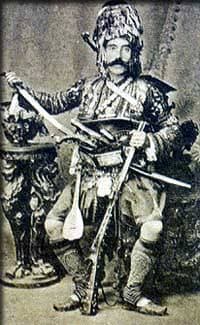
Throughout the Aegean world, ancient religious traditions have often survived in unexpected forms, preserved not through formal theology but through dance, music, ritual, and collective memory
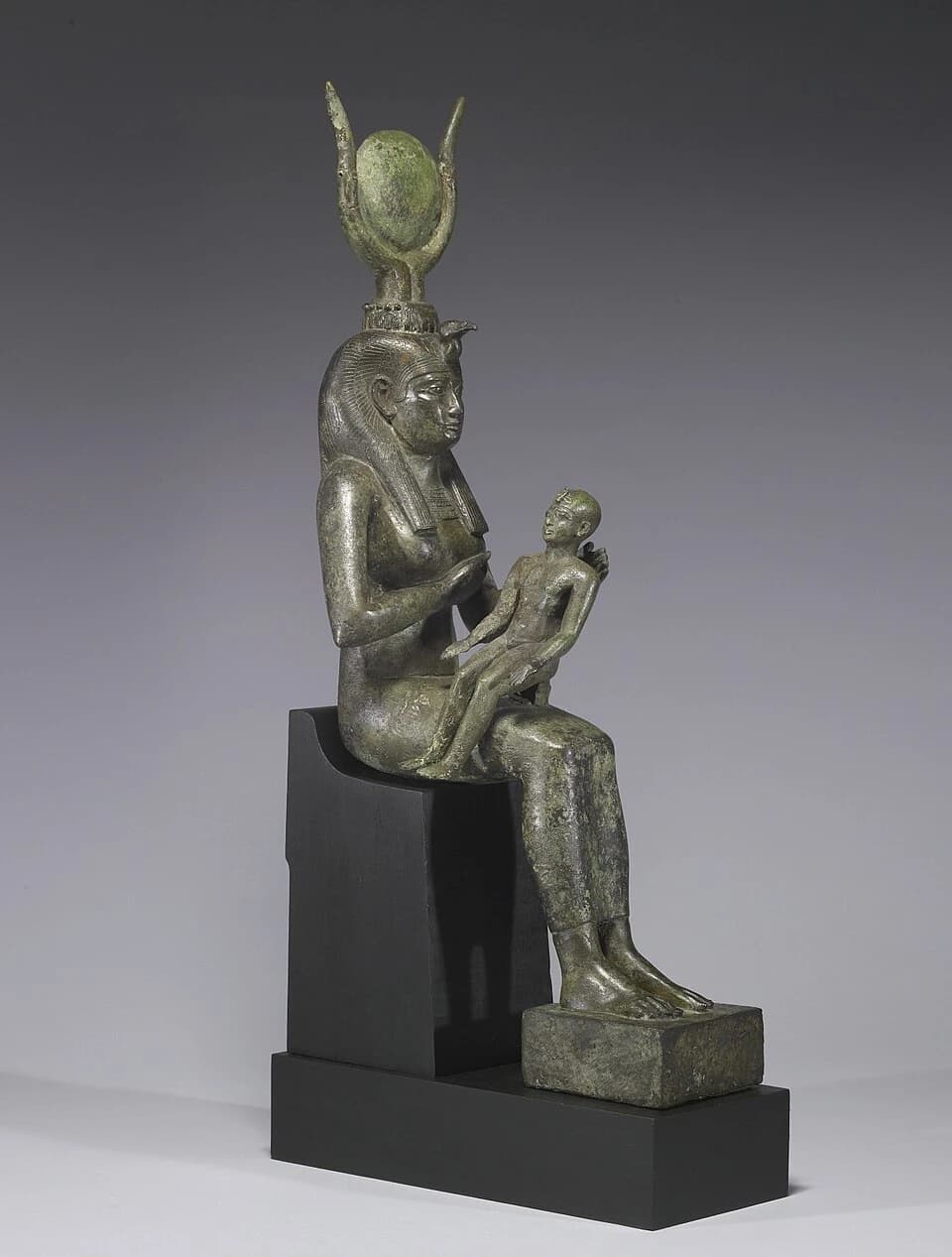
The Esoteric Teachings of the Planet Isis
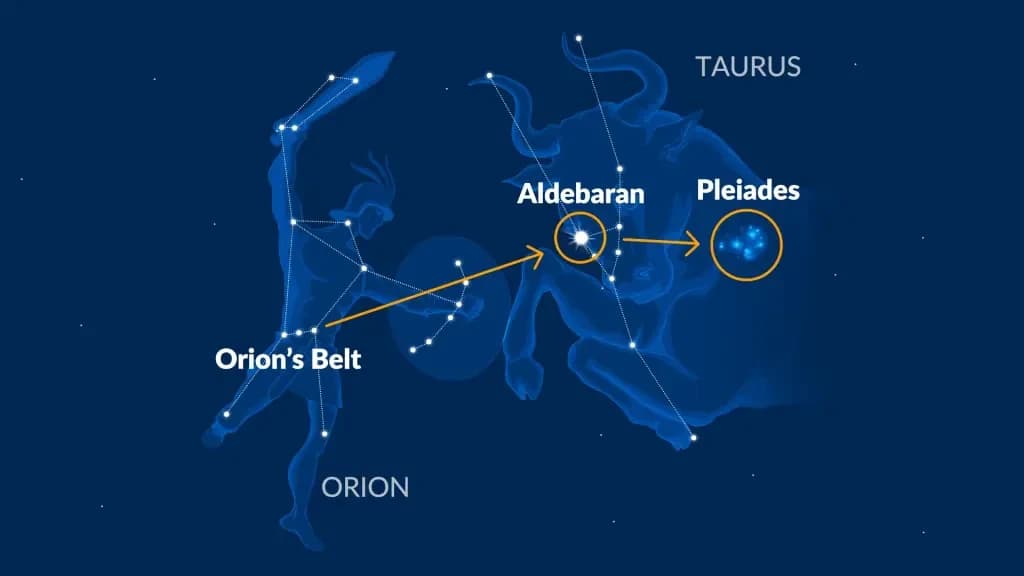
Isis is the co-ruler of the sign of Taurus and exalted in Libra; Pluto remains unaffected by this and is the co-ruler of the sign of Aries and exalted in Scorpio. Consequently, there is a great deal of confusion circulating regarding these two axes of rulership, leading to significant misinterpretations in practical astrology.

The Journey of the Soul
It should be common knowledge that, in traditional esoteric cosmology, the soul does not simply appear in the world, but rather makes its way down from the Light into matter. Along this path, it must take on the negative qualities of the seven guides in its impending incarnation and cross so-called thresholds, gates guarded by their keepers. This obstacle also exists on the path back to Kether, to the light from which it once fled.