Codex Markings▾
As Above, so Below: The Mirrored Principle of the Tree of Life
Most scholars of the occult have become aware of the rich symbolism and profound wisdom of Kabbalistic teachings from their earliest studies.
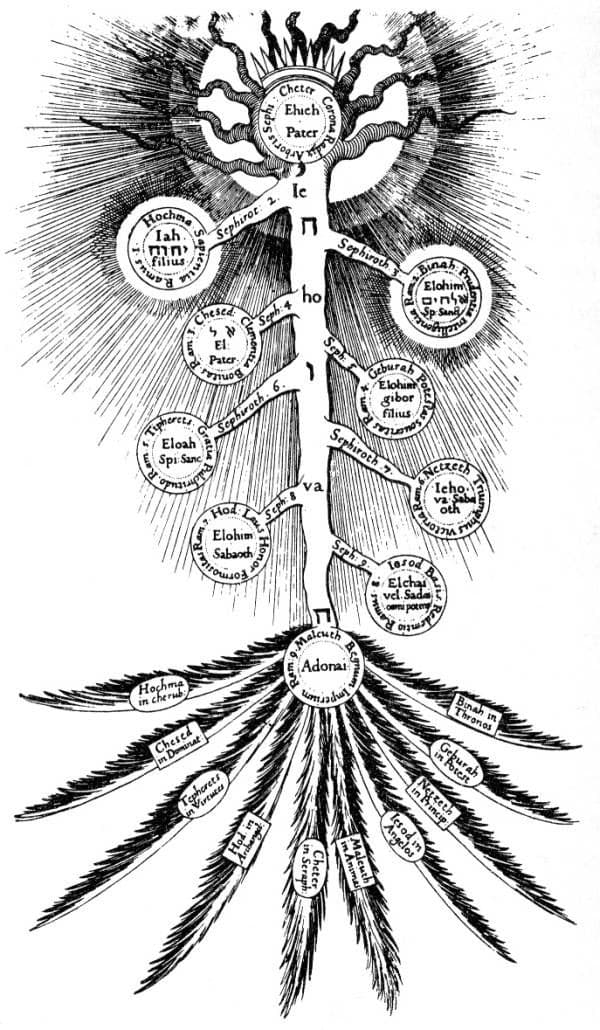
The “Tree of Life” is a visual representation of a cosmic order that serves as a symbol of the connection between Heaven (Macrocosm), Earth (Microcosm) and the Underworld (Prima Materia), as well as of immortality and the awe-inspiring nature of the universe.
The question that now remains open, and which is open to many different interpretations, is following: “Why does the divine descent from Kether to Malkuth; but from the human perspective, it becomes an ascent from grotesque matter to subtle spirit?”
This supposed inversion is not a contradiction, but rather a perspective on how a cosmic concept is viewed. This structure can be seen in different ways, depending on how consciousness is viewed:
From Above (Cosmological Emanation)
From Below (Human Emanation)
This hermetic principle “As Above, so Below”, mirrors the essence of many dualistic principles:
-
Heaven - Earth
-
Object - Subject
-
Emanation - Return
-
Observer - Reflection
The Tree as a universal Structure
The Tree of Life is not confined to Jewish Mysticism; rather, it is a universal symbol that serves as a metaphysical model of manifestation, consciousness, hierarchy, or also as a distinction from the “Monad”.
Alongside, the Norse Yggdrasil, the World Tree that supports the nine realms, we find the symbolism of the Tree as a manifestation of reality in almost every major civilization:
-
Ancient Egypt: Skyomore, the “threshold-tree” between life and death connected the world of the living with the afterlife, from where the goddess Hathor would often emerge to offer food and drink to the souls.
-
Jewish Kabbalah: Etz Chaim (Tree of Life), a diagram of divine reality which, through ten Sephiroth, illustrates how the divine light descends into the material world.
-
Buddhism: The Bodhi Tree represents the place of ultimate realization; the center of reality where the mind pierces through the illusion of the world and attains enlightenment.
-
Mayan culture: Jian-Mu stands at the center of the world; it serves as a ladder for Gods and Sages to travel between Heaven and Earth and reflects a reality in which the earthly and the divine are inextricably intertwined.
-
Vedic tradition: The Ashvattha Tree is often depicted upside down to elucidate that the origin of our visible reality lies in a spiritual, transcendent dimension.
Many cultures, and others besides, regard the tree as the “Axis Mundi” (axis of the world). It serves as a visual framework for existence, signifying that reality is not flat but possesses a vertical depth.
Thus, the Kabbalistic “Tree of Life” serves as a map showing us how the primordial unity of heaven descends, through the levels of the Sephiroth, into the diversity of earthly matter. Kether is rooted in the light of unity and branches out downwards into reality until it finds its energetic point of crystallization in Malkuth. A closed cycle in which fertility and immortality are ensured through the constant flow of energies between the Sephiroth.
An active process, like a living organism, drawing nutrients and water from the soil through its roots; rays of sunlight from above circulate within it, intertwining and reinforcing one another, a constant transformation of spirit into matter and matter into spirit.
Macrocosm: The Tree from a Cosmological Perspective
I hope it is now clear to the reader how the reality of the “Monad” descends from above into diversity below.
The spirit becomes increasingly condensed from level to level, moving ever closer to matter; transcendence manifests itself in form, much like the incarnation of the Word of God in Jesus Christ. If the incarnation of the divine is possible, then so too is the deification of mankind.
In this process, the universe, just like ourselves, crystallizes as pure consciousness.
Microcosm: The Tree from a Human Perspective
The view from our perspective of the Divine lies in the lower part of the tree: Malkuth. In contrast to cosmic unity or the Divine, we do not experience existence as flowing downwards from Kether; rather, we awaken in Malkuth, moving towards the light. Here the inversion becomes clear, and an experience emerges that one can truly relate to. This is the central insight.
The embodiment of the self inevitably begins with a sense of matter, fragmentation and egocentric identity. In these lower realms, we perceive the world as separate from ourselves, as a kind of collection of objects lying outside our self.
What is, from a divine perspective, an outpouring of abundance, is for us a gradual reintegration of our own parts. As our consciousness awakens within the structure, the path back to unity appears to us as an arduous ascent. However, herein lies the necessary rationale for the inversion of perception.
The reflection of the Tree is therefore not merely a graphic representation, but the consequence of our perspective. We stand at the base of a trunk and look upwards. The end of the Macrocosm is matter, which defines our starting point. Spiritual realization is thus not the attainment of a distant place, but a recollection of our original state. Climbing the ladder is not a farce to become something new, but rather to peel away the illusion of separation until we come to realize that the roots we suspect lie in the darkness of matter actually draw their strength from the light above.
Thus, the tree serves as a mirror for humanity: Those who dare to glimpse deep into their own “Underworld” will not only find their ego, but also the hidden seed of unity, who is waiting, to grow upwards once more.
The Mirror Principle: The Tree as a Self-Reference
This reversal of perspective is not a coincidental manifestation, but rather the revelation of a deeper, hermetic truth. From this perspective, we recognize that subject and object are not separate from one another, but are reciprocal reflections. In this structure it is revealed that the inner and the outer are structurally homologous.
This reflexivity leads to a substantial realization: Consciousness and the Universe are not separate entities that come into contact with one another, but rather part of a single, inseparable geometry.
Phenomenology of Being
In phenomenology and C.G. Jung’s psychology, we find confirmation of this principle: The individual can never view the world “objectively” from the outside. Since we are situated within the system, all our insights are self-referential. The tree only appears ‘upside down’ to us because every system exhibits a completely different dynamic from the inside than it does when viewed from above.
It is the ultimate application of the Hermetic Maxim “As above, so below”:
-
The Macrocosm is the tree that unfolds into matter.
-
The Microcosm is the tree that recognizes itself in the mind.
The Tree of Life is thus not a static object, but rather a dynamic matrix that is brought to life only through consciousness. We are the process of the tree becoming aware of itself.
Sign in to leave a mark.
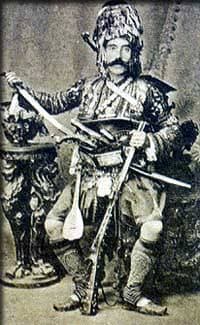
Dionysian Echoes in the Aegean: The Zeybeks of Anatolia and the Maenads of Pelion
Throughout the Aegean world, ancient religious traditions have often survived in unexpected forms, preserved not through formal theology but through dance, music, ritual, and collective memory
The Journey of the Soul
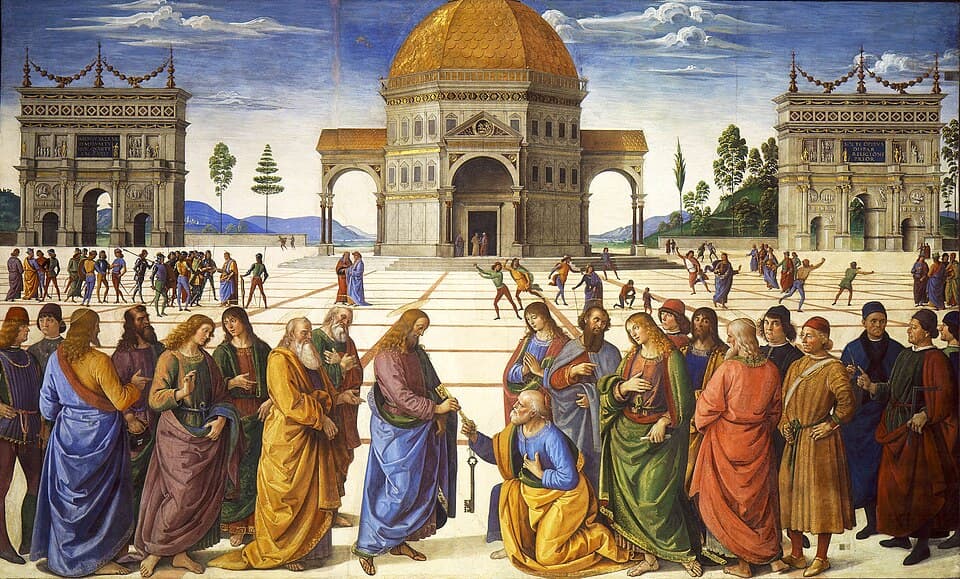
It should be common knowledge that, in traditional esoteric cosmology, the soul does not simply appear in the world, but rather makes its way down from the Light into matter. Along this path, it must take on the negative qualities of the seven guides in its impending incarnation and cross so-called thresholds, gates guarded by their keepers. This obstacle also exists on the path back to Kether, to the light from which it once fled.
The Esoteric Teachings of the Planet Isis
Isis is the co-ruler of the sign of Taurus and exalted in Libra; Pluto remains unaffected by this and is the co-ruler of the sign of Aries and exalted in Scorpio. Consequently, there is a great deal of confusion circulating regarding these two axes of rulership, leading to significant misinterpretations in practical astrology.